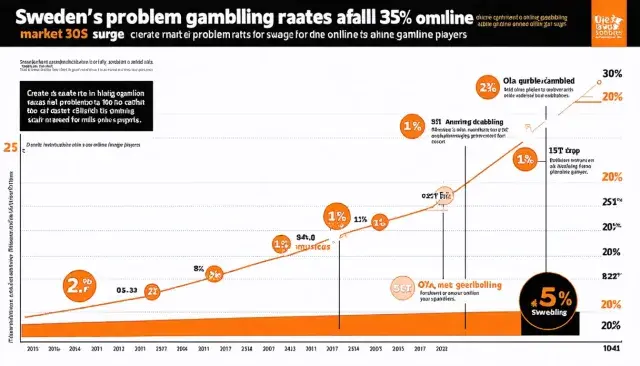
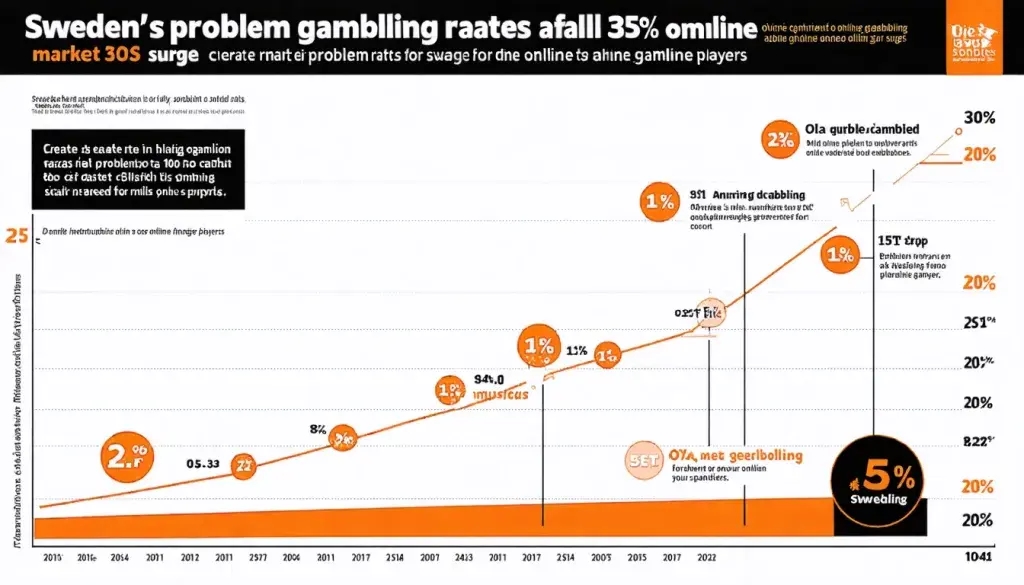
The proportion of Swedish adults facing problem gambling has dropped from 2.2% in 2008-09 to 1.3% in 2021, according to a report by economist Ola Nevander for the Swedish Trade Association for Online Gambling (BOS). This decline, equating to 57,000 fewer problem gamblers, persisted even as the online gambling sector expanded rapidly with higher marketing spends and universal digital access. Such trends challenge assumptions linking market growth directly to rising addiction rates.
Declining Prevalence Despite Expansion
The report relies on the Problem Gambling Severity Index (PGSI) to track changes, showing at-risk gamblers (PGSI 1+) also fell by about 200,000 over the period. Severe cases (PGSI 8+) held steady at 0.3% to 0.6%. Among past-year online gamblers, problem rates plunged from 12% in 2008-09 to roughly 4% from 2018 to 2021. Gambling participation remains high: 18% played online casino games and 24% bet online in 2025, per Casinofeber data. Marketing budgets rose ninefold in real terms from 2000 to 2024, peaking in 2018 before the 2019 licensing reform, while casino offerings grew over tenfold by 2019 and smartphone access hit near 100% by 2020.
Channelisation Drives Consumer Protections
Sweden achieves 85% channelisation into licensed operators, slightly lower for casinos, enabling uniform safeguards like duty-of-care duties, self-exclusion via Spelpaus, and data monitoring. As of March 2026, Spelpaus lists 136,000 users, or 1.6% of adults, though half reportedly gamble onward through unlicensed sites. Neighbors vary: Norway and Denmark reach 91.5% and 91%, Finland lags at 48% before reforms. The 2019 re-regulation imposed operator obligations, fostering these tools amid market liberalisation.
Treatment Insights and Regulatory Outlook
Machine-learning on transaction data predicts risks, pending full evaluations, while cognitive behavioural therapy (CBT) reduces gambling extent, frequency, and addiction symptoms versus controls, per meta-analyses. Psychologist Jakob Jonsson advocates centralised systems to counter anonymity: “Many people feel completely anonymous, as if no one can see what they are doing.” Policy debates continue; ATG's Hasse Lott Skarplöth seeks tax differentiation for racing bets, akin to UK changes. Tax expert David Sundén views Sweden's framework as solid yet improvable, cautioning against neighbors' pitfalls: “The main lesson for Sweden is rather what to avoid. There is no country that stands out as clearly superior.”