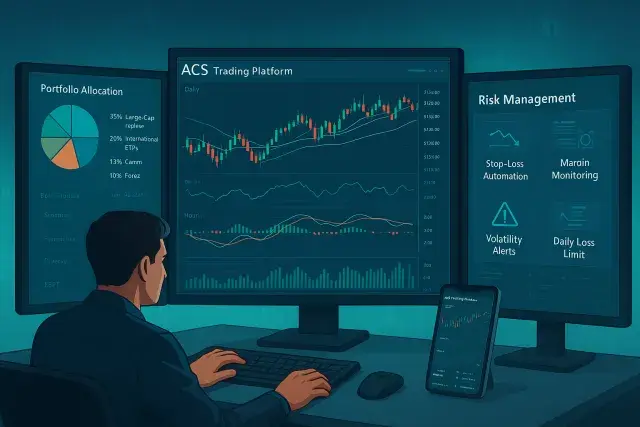
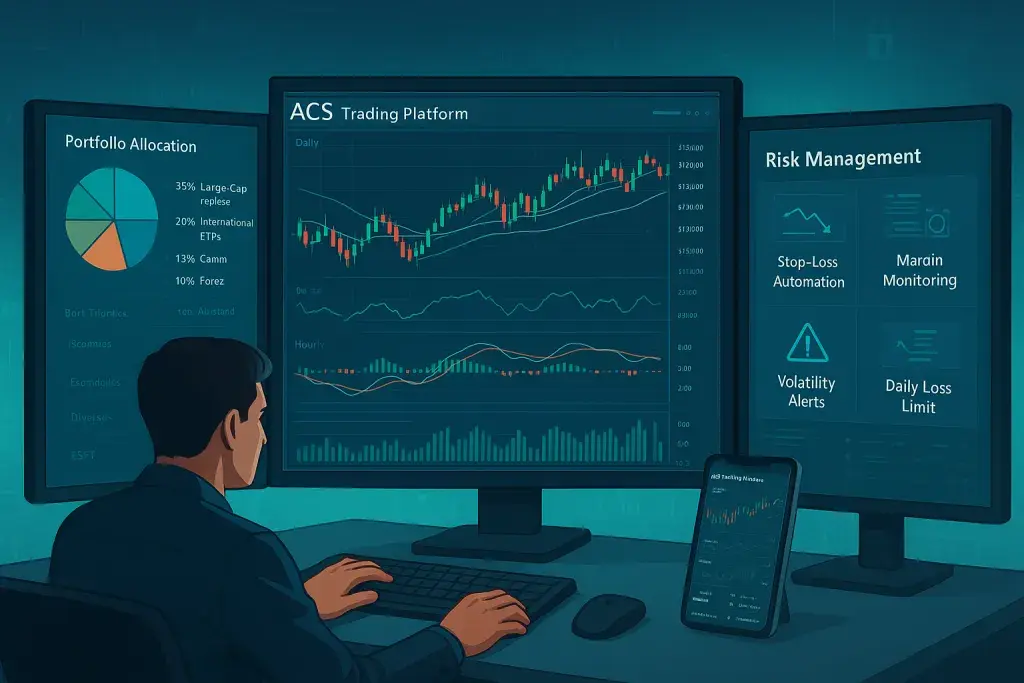
Most traders spend more time choosing a brokerage account than they do designing an actual investment strategy. That imbalance quietly costs them - because the platform you trade on shapes every decision you make, from how you read a chart to how quickly an order executes in a volatile market. The infrastructure matters as much as the idea behind the trade.
ACS has built its presence in financial services by addressing that gap: combining trading execution with structured analytical tools and a range of market access points that serve both active traders and longer-term investors. For those who want to understand exactly what this ecosystem offers, the acs market platform provides a useful starting point for exploring how integrated financial services can support smarter, more disciplined trading behavior across asset classes.
This guide covers the ACS trading platform from the ground up - its structure, supported markets, analytical capabilities, and the investment strategies best suited to its toolset. It also addresses risk management, regulatory considerations, and how ACS compares to competing platforms. Whether you are evaluating ACS for the first time or looking to get more from a platform you already use, this guide is designed to give you a clear, honest picture of what it offers and how to use it effectively.
What Is the ACS Trading Platform? Core Overview and Purpose
Before examining specific tools or strategies, it is worth establishing what ACS actually is and where it fits within the broader financial services landscape. The term "trading platform" is applied broadly across the industry - covering everything from simple retail brokerage apps to complex institutional execution environments. ACS occupies a specific position within that spectrum, and understanding that position shapes how you approach every other aspect of its use.
Background and Origins of ACS Financial Services
ACS financial services developed in response to a persistent problem in retail and semi-professional trading: the fragmentation of tools. For years, traders had to combine a brokerage account for execution, a third-party charting platform for analysis, an external news feed for fundamentals, and a separate risk calculator for position sizing. Each transition between tools introduced delay, friction, and the possibility of error.
ACS was designed to consolidate these functions into a single, coherent environment. Its financial services model sits somewhere between a traditional brokerage and a full-service trading terminal - offering direct market access alongside built-in analysis, rather than treating those functions as separate products. This integrated approach distinguishes it from platforms that focus exclusively on order execution or, conversely, platforms that provide analysis but rely on third-party brokers for execution.
It is worth distinguishing clearly between a trading platform and a financial services provider. A trading platform is the interface and technology layer through which orders are placed and managed. A financial services provider encompasses a broader set of functions - custody, compliance, reporting, advisory tools, and capital management infrastructure. ACS operates across both definitions to varying degrees, which is part of what makes it relevant to a wider range of users.
- Consolidated execution and analysis within a single environment
- Designed for retail investors, active traders, and semi-professional users
- Positioned between traditional brokerage and full trading terminal
- Emphasis on reducing tool fragmentation and decision latency
Platform Architecture and Key Features
The ACS trading platform is built around a layered architecture that separates the execution engine from the analytical interface while keeping them tightly integrated. Orders are processed through a direct market access layer that supports multiple order types, while the analytical interface operates on real-time or near-real-time data feeds. Both layers communicate with minimal latency, which matters in fast-moving markets where a delayed chart update can distort a trade decision.
The platform supports desktop and mobile environments, with feature parity between them that is more complete than most comparable platforms manage. The mobile interface is not a stripped-down version of the desktop - it supports charting, order management, and alerts with equivalent depth, which is relevant for traders who monitor positions across different contexts throughout the day.
| Feature | ACS Offering | Industry Standard | Assessment |
|---|---|---|---|
| Charting tools | Multi-timeframe with custom indicators | Basic charting with standard indicators | Above average |
| Order types | Market, limit, stop, trailing stop, conditional | Market and limit orders standard | Competitive |
| Asset coverage | Equities, forex, commodities, ETFs, derivatives | Varies widely by provider | Broad |
| Mobile experience | Full feature parity with desktop | Often reduced functionality on mobile | Strong |
| API access | Available for algorithmic integration | Not universally offered at retail level | Above average |
Who Uses ACS and Why
The platform serves several distinct user profiles, and each one interacts with ACS financial services differently. Retail investors - those managing personal portfolios without professional infrastructure - tend to value the consolidated environment, using ACS for both portfolio tracking and opportunistic trading. Active day traders prioritize execution speed and charting depth. Semi-professional traders and financial advisors use the platform's data feeds and reporting features to support client-facing work.
- Retail investors seeking an integrated platform for personal portfolio management
- Day traders requiring fast execution and detailed technical analysis tools
- Swing traders who rely on multi-timeframe analysis and conditional orders
- Financial advisors using platform data to support client strategies
- Algorithmic traders building and deploying automated systems via API
Each group places different demands on the platform, and ACS's architecture is designed to accommodate that range without forcing every user into a single workflow. That flexibility is one of the clearest reasons different trader types are drawn to the same environment.
Navigating the ACS Stock Exchange: Access, Assets, and Market Structure
Understanding what you can trade, and under what conditions, is foundational to using any platform effectively. The ACS stock exchange dimension - meaning the markets and instruments accessible through the platform - defines both the opportunity set and the operational constraints that shape every trading decision.
Supported Markets and Asset Classes
ACS provides access to a range of asset classes that covers most of what retail and semi-professional traders require. Equities across major exchanges, foreign exchange pairs, commodity contracts, exchange-traded funds, and derivative instruments including options and futures are all accessible within the platform environment. This breadth means that most diversification strategies can be executed without needing to maintain accounts on separate platforms.
| Asset Type | Market Access | Trading Hours | Liquidity Level | Notes |
|---|---|---|---|---|
| Equities | Major global exchanges | Exchange-specific sessions | High for large-cap stocks | Pre/post-market access may vary |
| Forex | Spot and forward markets | 24 hours on trading days | Very high for major pairs | Spreads vary by session |
| Commodities | Futures and spot contracts | Extended hours for many contracts | Moderate to high | Seasonal volatility factors apply |
| ETFs | Exchange-listed products | Exchange trading hours | Varies by fund size | Useful for diversified exposure |
| Derivatives | Options and futures contracts | Contract-specific | Moderate | Requires understanding of expiry mechanics |
Order Types, Execution Mechanics, and Trading Conditions
The quality of order execution is one of the most consequential and least discussed aspects of choosing a trading platform. ACS supports a comprehensive order type library that goes beyond the basic market and limit orders most retail platforms offer. Trailing stop orders adjust automatically as price moves in a favorable direction, locking in gains without requiring manual intervention. Conditional orders allow traders to define multi-step logic - for example, triggering a buy order only if a specific price level is breached and a volume threshold is met simultaneously.
Execution speed matters most in volatile conditions. Slippage - the difference between the expected price of an order and the price at which it actually fills - tends to widen during news events, earnings releases, and macroeconomic data drops. ACS's execution infrastructure is designed to minimize this gap, though no platform eliminates slippage entirely in highly illiquid or fast-moving conditions.
Placing a trade on ACS follows a logical sequence that becomes intuitive quickly:
- Log in and open the trading interface for the target asset
- Review current price, spread, and available order types
- Define position size based on available capital and risk parameters
- Select order type and set any conditional parameters or stop levels
- Review the order summary, including estimated cost and margin requirement if applicable
- Confirm and submit the order
- Monitor the position and adjust stops or targets as market conditions evolve
Fees, Commissions, and Cost Transparency
Trading costs accumulate faster than most beginners expect, and the structure of those costs varies considerably across platforms. ACS financial services applies a fee model that combines per-trade commissions on equity transactions with spread-based pricing on forex and certain derivative products. Overnight financing charges apply to leveraged positions held beyond the daily session close - a cost that compounds significantly if leveraged trades are held for extended periods.
Withdrawal fees and account maintenance charges, where applicable, should be factored into the total cost calculation before committing capital. The real cost of a trade is not the commission alone - it is the sum of the spread, commission, any applicable financing charge, and the opportunity cost of capital tied up in margin requirements.
| Fee Type | ACS Structure | Typical Competitor A | Typical Competitor B | Reader Impact |
|---|---|---|---|---|
| Equity commission | Per-trade flat or percentage | Zero-commission model | Tiered by volume | Affects active traders most |
| Forex spread | Variable, tighter on majors | Fixed spread model | Variable spread | Key cost for high-frequency traders |
| Overnight financing | Benchmark rate plus margin | Benchmark rate plus margin | Flat daily charge | Critical for leveraged swing trades |
| Withdrawal fee | Varies by method | Often free for standard methods | Fee per withdrawal | Minor but worth confirming |
A practical approach: before executing a new strategy, calculate the break-even point including all applicable fees. A trade that looks profitable on raw price movement may generate a net loss once spread and financing are accounted for, particularly on smaller position sizes or shorter holding periods.
ACS Market Analysis: Tools, Methodologies, and Data Interpretation
The ability to execute trades efficiently is only as valuable as the quality of the analysis behind those trades. ACS market analysis tools cover both the technical and fundamental dimensions of market research, giving traders access to the data and interpretive frameworks they need without requiring them to leave the platform environment.
Technical Analysis Tools Available on ACS
ACS provides a charting environment that supports multiple timeframes simultaneously - a feature that serious technical traders consider non-negotiable. Analyzing a stock or currency pair on a daily chart while referencing an hourly chart for entry timing is a standard workflow, and the platform accommodates it without requiring multiple windows or account logins.
The indicator library includes the full range of standard technical tools: moving averages in multiple configurations, Relative Strength Index for momentum measurement, Moving Average Convergence Divergence for trend and momentum confirmation, Bollinger Bands for volatility context, and volume-based indicators that help validate price movements. Beyond the standard library, the platform supports custom indicator scripting for traders who want to build proprietary signals.
Consider a practical scenario: a trader watching a mid-cap equity that has been in a downtrend for several weeks. On the daily chart, price approaches a well-established support level. On the hourly chart, RSI begins moving out of oversold territory while MACD lines cross bullish. Volume increases on the hourly candle that breaks a short-term resistance. Each of these signals, individually, is inconclusive. Together, on an ACS chart displaying all simultaneously, they form a coherent basis for a considered entry decision.
- Moving averages: trend direction and dynamic support/resistance identification
- RSI: momentum strength and potential reversal zones
- MACD: trend confirmation and momentum crossovers
- Bollinger Bands: volatility context and breakout identification
- Volume indicators: validation of price moves and detection of accumulation/distribution
- Custom scripts: proprietary signal construction for experienced traders
Fundamental Analysis and Financial Data Integration
Technical analysis tells you how a price is moving. Fundamental analysis tells you why it might be justified - or why it might not be. ACS market analysis integrates key fundamental data points directly into the trading environment, reducing the need to switch between the platform and external financial databases for routine research.
Available fundamental data includes earnings reports and per-share earnings history, price-to-earnings ratios, dividend yield and payment history, and macroeconomic calendar events with expected and actual result tracking. News feeds integrated into the platform provide real-time context for price movements, allowing traders to connect chart activity to underlying catalysts quickly.
A brief definitional note for newer traders: technical analysis is the study of price and volume patterns to forecast future price behavior. Fundamental analysis evaluates the intrinsic value of an asset based on financial performance, economic conditions, and business quality. Most experienced traders use both in combination, applying fundamentals to select what to trade and technicals to determine when and at what price to enter or exit.
| Data Type | Available in ACS | Requires External Source | Suggested External Source |
|---|---|---|---|
| Earnings reports | Yes - historical and upcoming | Rarely needed | Company investor relations pages |
| P/E ratio and valuation metrics | Yes - standard metrics included | For deep comparative analysis | Financial data aggregators |
| Dividend data | Yes - yield and payment history | Rarely needed | Dividend-focused databases |
| Macroeconomic calendar | Yes - with consensus estimates | For granular central bank analysis | Dedicated economic calendars |
| Balance sheet depth | Partial - summary level | For detailed credit or ratio analysis | Financial statement databases |
| Sector/industry benchmarking | Limited | Often needed for comparative work | Sector-focused research platforms |
Sentiment Analysis and Real-Time Market Intelligence
Sentiment analysis sits at the intersection of behavioral finance and data aggregation. The underlying logic is straightforward: markets are moved by the collective decisions of participants, and those decisions are influenced by perception as much as by hard data. Measuring the direction and intensity of market sentiment can provide an early signal before that sentiment fully translates into price movement.
ACS provides sentiment indicators that aggregate positioning data, news sentiment scoring, and in some cases social signal inputs to give traders a directional read on market mood. A practical example: if a major commodity is showing predominantly bearish news sentiment while price holds at a technical support level, the divergence between sentiment and price action is itself informative - suggesting either that the market has already priced the bad news, or that a delayed break lower is pending.
One important caution: sentiment signals are directional, not deterministic. A market that is extremely bearishly positioned can remain under selling pressure for longer than any contrarian trade can survive. Sentiment data is most useful as a secondary filter layered over technical and fundamental analysis, not as a standalone trading trigger. Over-relying on sentiment without price confirmation is a consistent source of poorly timed entries.
ACS Investment Strategies: Frameworks for Different Investor Profiles
Access to good tools does not automatically produce good outcomes. What matters is how those tools are organized into coherent strategies that match the investor's time horizon, risk tolerance, and capital base. ACS investment strategies span a wide range - from intraday trading frameworks to long-term portfolio construction - and the platform's design supports each approach with relevant functionality.
Short-Term Trading Strategies on ACS
Short-term trading encompasses a spectrum of approaches, from scalping - holding positions for seconds to minutes - through to swing trading, where positions are held for several days based on anticipated price swings. Each approach places different demands on the platform and requires a different analytical framework.
Scalping on ACS relies heavily on execution speed, tight spreads, and reliable charting at one-minute and five-minute timeframes. The strategy involves identifying high-probability, small-movement opportunities and executing a large number of trades to accumulate returns. The margin for error is narrow, and costs - particularly spreads - consume a larger proportion of potential profit than they do on longer-horizon trades.
Swing trading is less execution-sensitive and more analysis-intensive. A trader using ACS tools for swing trading might build a position based on a daily chart breakout, use the hourly chart for precise entry timing, and set a trailing stop to protect accumulated gains as the trade develops over several days.
Building a short-term trading plan using ACS tools follows a logical sequence:
- Define the asset universe - which markets and instruments you will trade
- Establish the timeframe - scalping, intraday, or multi-day swing
- Select the technical indicators that will define entry and exit signals
- Set maximum position size and loss limits per trade and per day
- Run the strategy against historical data using the platform's backtesting tools
- Execute on a demo account to validate without capital risk
- Transition to live trading with reduced position sizes until the strategy performs consistently
Long-Term and Portfolio-Based Investment Strategies
Long-term investing through the ACS stock exchange environment operates on different logic than active trading. The primary goal shifts from capturing short-term price movements to building wealth through compounding returns over years or decades. The platform's analytical tools are still relevant here, but the frequency of their use changes - weekly or monthly reviews replace daily monitoring.
Core principles of long-term investing apply within ACS as they do anywhere: diversification across asset classes and geographies reduces concentration risk. Dollar-cost averaging - investing a fixed amount at regular intervals regardless of price - reduces the impact of timing errors. Periodic rebalancing ensures that portfolio allocations stay aligned with original targets as different assets appreciate or depreciate at different rates.
- Diversification: spread capital across uncorrelated assets to reduce single-event risk
- Dollar-cost averaging: reduce timing risk by investing consistently over time
- Rebalancing: maintain target allocations by trimming outperformers and adding to underperformers
- Dividend reinvestment: compound returns by reinvesting income distributions
- Cost control: minimize drag from fees and taxes over long holding periods
| Strategy Type | Time Horizon | Primary ACS Tools Used | Risk Level | Expected Return Profile |
|---|---|---|---|---|
| Scalping | Seconds to minutes | 1-min/5-min charts, execution engine | High - requires precise execution | Small gains per trade, high frequency |
| Day trading | Intraday, no overnight holds | Technical indicators, news feed, alerts | High - volatile intraday moves | Medium per trade, moderate frequency |
| Swing trading | Days to weeks | Daily/hourly charts, fundamental data | Moderate | Larger per-trade moves, lower frequency |
| Buy and hold | Years to decades | Fundamental data, portfolio tracker | Low to moderate | Compounding growth over time |
| ETF portfolio | Long-term with periodic review | Asset class coverage, rebalancing tools | Low to moderate | Diversified market returns |
Algorithmic and Automated Trading on ACS
Algorithmic trading removes the emotional component from trade execution by defining entry, exit, and risk management rules in advance and allowing a system to execute them automatically. ACS supports this through API access that allows external systems to interact with the trading environment, as well as built-in strategy tools for traders who prefer to work within the platform rather than code external applications.
The prerequisite for effective algorithmic trading is a well-defined, testable strategy. Automation does not improve a flawed strategy - it executes it faster and more consistently, which means it also produces losses faster if the underlying logic is unsound. Before deploying any automated system on ACS, backtesting against historical data is essential. Backtesting reveals whether the strategy's rules would have produced acceptable results across different market conditions, including periods of high volatility, trending markets, and range-bound environments.
For traders new to automation, a practical starting point is to automate only the parts of a strategy that do not require judgment - specifically, stop-loss management and take-profit exits on positions that were entered manually. This hybrid approach reduces emotional interference on the exit side while keeping the human in the loop for entry decisions, where contextual judgment still adds value.
A critical warning: automated systems require ongoing monitoring. Market conditions change, and a strategy optimized for one regime - trending, low-volatility environments, for example - may perform poorly or produce significant losses in a different regime. Set defined circuit-breakers: maximum daily loss limits that shut the system down if breached, giving you time to assess whether the strategy has stopped working or whether conditions are temporarily abnormal.
Diversification and Multi-Asset Strategy Using ACS
One of the clearest practical advantages of the ACS trading platform is its multi-asset access within a single account environment. A diversified portfolio that spans equities, commodities, foreign exchange, and fixed-income proxies through ETFs can be constructed, monitored, and rebalanced entirely within the platform - without the administrative friction of managing positions across multiple accounts and institutions.
Effective diversification is not simply holding many different things. Assets that are highly correlated - meaning they tend to move in the same direction in response to the same events - provide limited protective benefit from each other. True diversification requires combining assets with low or negative correlation, so that when one portion of a portfolio is under pressure, another is stable or appreciating.
| Asset Class | Example Allocation % | Rationale | Risk Level | Primary ACS Tool |
|---|---|---|---|---|
| Large-cap equities | 35% | Core growth exposure | Moderate | Stock screener, fundamental data |
| International equity ETFs | 20% | Geographic diversification | Moderate | ETF coverage, charting tools |
| Commodities | 15% | Inflation hedge and low equity correlation | Moderate to high | Futures contracts, technical analysis |
| Forex pairs | 10% | Currency exposure and liquidity | High | Forex execution, sentiment tools |
| Bond ETFs | 20% | Stability and negative equity correlation | Low | ETF coverage, portfolio tracker |
The allocations above are illustrative, not prescriptive. The appropriate structure depends on the investor's age, income, time horizon, liquidity needs, and risk tolerance. The point is that ACS investment strategies built around genuine multi-asset diversification can be implemented and managed within one unified platform environment.
Risk Management on the ACS Platform
No matter how well-constructed a strategy is, it will encounter losing periods. The difference between traders who survive those periods and those who do not comes down almost entirely to risk management discipline. ACS provides a set of built-in tools to support that discipline, but the ultimate responsibility rests with the trader.
Built-In Risk Controls and Safety Features
The ACS trading platform includes several risk management mechanisms that traders can configure at the account and position level. Stop-loss automation is the most fundamental: once set, a stop-loss order closes a position automatically if price moves against it beyond a defined threshold, preventing a manageable loss from becoming a catastrophic one through inaction or distraction.
Margin controls on leveraged positions define the maximum exposure relative to available capital. When a position moves against a leveraged trader and account equity approaches the minimum margin requirement, the platform triggers a margin call - requiring either additional capital or position reduction. ACS's margin controls provide real-time visibility into how close a portfolio is to that threshold, giving traders the information they need to act before a forced liquidation occurs.
- Stop-loss orders: automatic position closure at a pre-defined adverse price level
- Trailing stops: dynamic stop adjustment as price moves favorably
- Margin monitoring: real-time visibility into leverage levels and margin requirements
- Volatility alerts: notifications when an asset's price moves beyond defined thresholds
- Position size calculator: tool for computing appropriate position sizes relative to account risk
- Daily loss limits: optional account-level caps that prevent further trading after a set loss
One distinction that every trader must internalize: platform-level risk controls manage execution mechanics. They do not manage strategy risk, psychological risk, or the risk of trading with a fundamentally flawed approach. A stop-loss prevents a runaway loss on a single trade. It does not prevent a trader from re-entering the same poor trade repeatedly after being stopped out. That requires a different kind of discipline entirely.
Common Risk Mistakes Investors Make on Trading Platforms
Platform capability does not prevent behavioral errors. The most consistently damaging mistakes in trading are not technical - they are psychological and structural. Understanding them in advance is one of the few ways to reduce their impact before they occur.
Consider a straightforward scenario: a trader opens a leveraged position expecting a short-term price move. The market moves slightly against them. Instead of accepting the loss at the pre-defined stop level, they remove the stop and add to the position - "averaging down" in the belief that the market must eventually return to their entry price. It does not. Within days, a loss that would have been manageable at two percent of the account has consumed twenty percent. This sequence plays out repeatedly across all asset classes and experience levels.
- Over-leveraging: using maximum available leverage without accounting for normal price volatility
- Removing stop-loss orders: abandoning risk controls in response to short-term adverse moves
- Overconcentration: allocating a disproportionate share of capital to a single position or sector
- Revenge trading: increasing position sizes after a loss to recover quickly, compounding the problem
- Ignoring fees: failing to account for spread, commission, and financing costs in strategy planning
- Emotional entry: entering trades based on fear of missing a move rather than defined signals
- Skipping the demo environment: trading live capital before adequately testing a new strategy
Comparing ACS With Other Trading Platforms and Financial Services
No platform exists in isolation. Understanding where ACS stands relative to its alternatives is essential for making an informed choice, particularly for traders who have already used other environments and want to know what they would gain or give up by switching.
ACS vs. Major Competing Platforms
The competitive landscape for trading platforms is broad, ranging from zero-commission mobile apps optimized for retail simplicity to professional-grade terminals designed for institutional workflows. ACS sits in the middle ground - more capable than consumer-level apps, more accessible than institutional terminals - which is both its strength and its competitive challenge.
| Criteria | ACS | Consumer-Level App | Institutional Terminal | Best For |
|---|---|---|---|---|
| Fee structure | Moderate - spread and commission | Zero commission, wider spreads | Low per-unit, high platform fees | Depends on trade frequency and size |
| Asset range | Broad - multi-asset | Often equities and ETFs only | Comprehensive across all classes | ACS for mid-range diversification |
| Analysis tools | Integrated technical and fundamental | Basic or minimal | Highly advanced | ACS for self-directed analysis |
| Automation support | API access available | Limited or none | Advanced scripting environments | ACS for mid-level algorithmic use |
| User experience | Accessible with depth | Very simple | Steep learning curve | ACS for experienced retail users |
| Customer support | Standard multi-channel support | Often automated only | Dedicated account management | ACS for general support needs |
Regulatory Standing and Security of ACS Financial Services
Regulatory compliance is the structural foundation of trust in any financial services platform. A platform may have excellent tools and competitive pricing, but if it operates outside a recognized regulatory framework, client funds and data are at meaningful risk.
Regulatory compliance means, in practical terms, that the platform is authorized and supervised by a recognized financial authority, that client funds are held in segregated accounts separate from the company's own operating capital, and that the platform adheres to defined standards for reporting, transparency, and dispute resolution. Segregated accounts are particularly important: they ensure that client money cannot be used to cover the platform's own liabilities in the event of insolvency.
Before placing capital on any trading platform, a trader should verify regulatory status independently - not through a link or claim on the platform's own website, but through the public register of the relevant regulatory authority. Regulatory bodies publish these registers online and they are searchable by company name and license number.
- Is the platform licensed by a recognized financial regulatory authority?
- Are client funds held in segregated accounts at a regulated bank?
- What investor compensation scheme, if any, applies to accounts held on the platform?
- What encryption and data security standards protect personal and financial data?
- Is there a clearly defined dispute resolution process independent of the platform itself?
- Has the platform been subject to any regulatory sanctions or investigations?
ACS financial services operates within a regulatory framework that requires it to meet defined standards of capital adequacy, client money handling, and operational transparency. Verifying the specific license and jurisdictional status directly with the relevant authority remains good practice regardless of the platform's stated credentials.
Getting Started on ACS: A Practical Onboarding Roadmap
Knowledge of what a platform can do is only valuable when converted into action. The transition from research to active use involves a defined set of steps that, when followed in order, significantly reduce the risk of early errors and help build a functional working relationship with the platform before real capital is involved.
- Create an account using the official ACS registration process, providing the required identification documents for regulatory verification
- Complete the identity verification process - typically involving government-issued ID and proof of address - before trading access is granted
- Make an initial deposit using your preferred payment method, confirming processing times and any applicable minimum deposit requirements
- Spend time in the platform orientation phase - explore the interface without placing trades, familiarizing yourself with chart layouts, order screens, and account settings
- Configure your risk settings: set default stop-loss parameters, margin alerts, and daily loss limits before placing any live trade
- Build and save your analytical workspace: organize watchlists, set up indicator configurations, and establish the charting layout you will use consistently
- Place your first trade after completing all preparation steps - starting with a position size well below your planned standard to test execution mechanics in live conditions
Before the first live trade, a pre-trade checklist matters more than most new traders realize:
- Risk parameters configured and tested
- Watchlists populated with target assets
- Charting layout saved with preferred indicators
- Notification preferences set for price alerts and margin warnings
- Fee structure confirmed for the instruments you plan to trade
- Strategy rules written down and reviewed
- Demo account testing completed for the intended strategy
For a new retail investor, the first week on ACS might look like this: day one through three focused entirely on platform orientation and demo trading - placing paper trades, exploring the charting tools, and testing order types without capital at risk. Day four involves reviewing the demo performance, identifying any gaps in the strategy, and making adjustments. Day five or six involves a first small live trade, using a position size of no more than one percent of available capital, specifically to experience live execution mechanics. That sequence - orientation, testing, small live exposure - is far more productive than depositing capital and immediately placing full-sized positions.
The most consistent mistake among new platform users is skipping the demo stage entirely. ACS market analysis tools and execution mechanics behave the same way in demo and live environments. The only difference is that mistakes in demo cost nothing. Using that environment deliberately and seriously before committing real capital is not a step to abbreviate.
Questions and Answers
How does ACS handle order execution during high-volatility market events?
During major market events such as central bank announcements or earnings releases, spreads typically widen and slippage risk increases on all platforms, including ACS. The platform's execution infrastructure is designed to process orders quickly, but limit orders provide more price certainty than market orders during volatile periods. Setting orders in advance of known high-volatility events - rather than entering at the moment of the news - reduces execution uncertainty significantly.
Can I use ACS investment strategies across multiple asset classes in a single account?
Yes. One of ACS's practical advantages is that equities, forex, commodities, ETFs, and derivatives can be held and managed within a single account environment. This means portfolio-level analysis - including correlation monitoring and overall risk exposure - can be conducted within the platform without consolidating data from multiple separate accounts.